Showing posts with label beer. Show all posts

Tuesday, December 24, 2013

Benelux April 2013 -- Odd Museums, Naughty Chocolate and Beer in Bruges

We spent a week in Bruges, so we had plenty of time to explore the unusual.  Bruges, and indeed, Belgium, is known for friet, chocolate and beer.  For some people that would be the 3 main food groups.  We made sure to visit museums devoted to the first two and the only brewery still functioning within the limits of  old town Bruges.

We both found the Friet Museum surprisingly informative and entertaining.  At the end, we were able to buy "authentically cooked" friet and they were very tasty.  The cone-shaped bag on the left of the picture is what they were served in.  I got a free one to bring home.  We each got a discount coupon, for the little friet shop, but we only got one bag of friet.  It was huge.


There was far too much historical and nutrition information on the walls to take  pictures of all of it, but this is an example of the kind of information designed especially for kids.  It was low on the wall and presented in Flemish and English.  As with the rest of the textual pictures, you will need to click on them to read the text.

Potatoes came to Europe when the Spanish explorers returned with them from South America.


This is the kind of  presentation designed for taller people.  Ergotism was a disease caused by the fungus that grew on rye grain, the primary grain used for bread.  It was also known as St. Anthony's Fire.  By the end of the 17th century, it started to abate because people were eating more potatoes and less rye bread.


Of course, there is always someone who thinks anything new is the work of the devil.


Potato cultivation advanced in Ireland faster than anywhere else.


Potatoes are a nutritious and delicious source of  vitamin C, magnesium, iron and potassium.


Now for that other vitamin C, chocolate.  The Chocolate Museum is devoted to the history of chocolate, not only the cultivation of it and the manufacture of candies, but also how it came to be a relished drink with specialized cups and saucers developed for drinking it.  If you go to the link, you can get to most of what we saw.  I took no pictures besides this one of  Trout.  We did partake of the chocolate drops as we entered and we did watch the demonstration at the end and sample what was made right there.  Two food groups down and one to go.


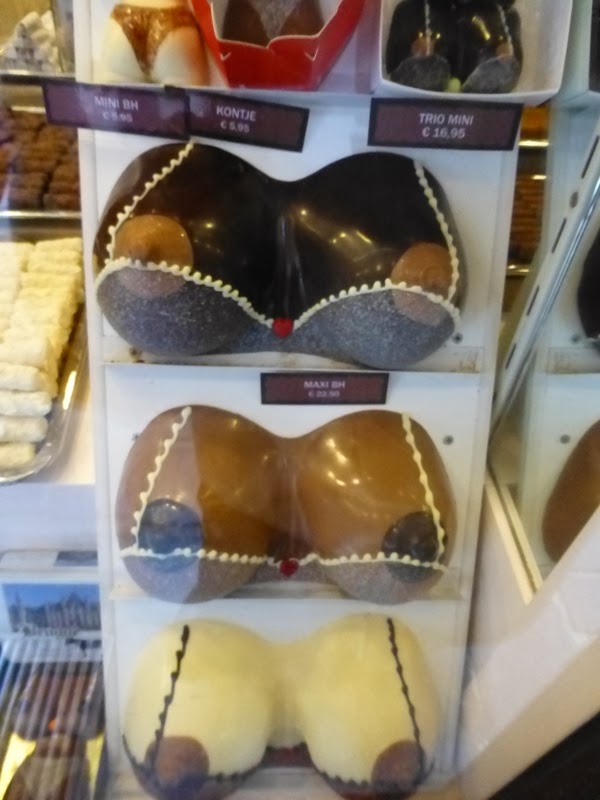
But before we go on to beer, these are some pictures from shop windows along the street.  There are several chocolate shops in Bruges, many that make their own.  Easter was over, but this guy was still in the window of this shop.  Not exactly the kind of Easter bunny we're used to seeing.  Belgian chocolate makes you strong!


This is pretty typical of what you might see in a window.


As are these pictures.  They are examples of some of the things you see in Europe that shock Americans.  No biggie over there, regardless of country.


It didn't matter what was displayed in the shop windows, no one was supposed to sit on the window sills.  At least these spikes weren't too pointy.


Now for the beer.  Trout didn't try as many kinds of beer as I expected him to.  We saw more than one shop like this one with a huge variety of beers and the kind of glass each is supposed to be served in.


We did take a special tour of De Halve Maan (half moon) brewery.  Click on the link to learn about its history.  There were many breweries in the town of Bruges, but this is the last one downtown that is still brewing beer.  

The tour is fascinating, but not accessible for anyone with mobility issues -- too many stairs and narrow stairways that you have to go down backwards.  These are pictures from the roof.


Trout wanted to make sure I got the smokestack.


This view is down to the part of the canal where the swans are.


Here you can see down into the courtyard and see two of the modern brewing vats.


After the tour, we went into the restaurant for our free beer.  Trout actually got a beer and I got a soda.  We did have a lovely meal, made all the more lovely because it was late for lunch and there were only a few people there.

After lunch, we decided it was time to get souvenirs.  I chose this University of Brugge T-shirt.  I like the color and the date the university was established.


 Things are so close and easy to walk to in Bruges, that we took in the Diamond Museum when we couldn't get tickets to the first Halve Maan tour we wanted to go on.  I could take no pictures, but the link has good information about the museum.  We were not able to time our visit so as to see the polishing demonstration.

This is it for the secular Bruges postings.  The rest should be more religious.


Sunday, November 15, 2009

Munich and Nurnberg

On September 10th, we drove through the fog from the Nurburgring to Koblenz, turned in our car at the train station and found a place to sit down and wait for the train to Munich. I originally planned for us to take a fast train (that would not go along the Rhine) with a change in Mannheim that would put us in Munich in time for a late lunch or early dinner. However, uncharacteristcally, the train I chose was running so late that we would miss our connection.

Fortunately, I had printed an alternative route along the Rhine which took longer, and changed in Ulm instead. We took that train and arrived in Munich later than originally planned but earlier than we probably would have otherwise. Thank goodness for the Deutche Bahn's online service. I used it for almost every route in the EU.

The hotel was just a few blocks from the train station, so we walked over and checked in. We went from that ultra-modern room at the Nurburgring to high German kitsch, complete with a canopy bed.


But they had the same kind of gizmo at the door. To save on electricity, you have to put your key card in this device. It turns on the power to everything except the TV as it turned out. It seemed to stay on even if the card was not in the slot. We encountered these in all the new and recently remodeled hotels we stayed in.

I chose this hotel partly due to its proximity to the train station and partly due to its proximity to the Augustiner beer garden. It is considered to be the oldest and largest beer garden in the world. The weather was wonderfully warm and we had a nice meal there.

Trout did yeoman service to the liter of beer and I helped with the pretzel, but he couldn't finish the beer and we didn't finish the pretzel in favor of our real food.

I took the picture below from the children's play area. It was on a slight hill above the beer garden with all kinds of play equipment and tables for the families to sit and eat and drink. Kids were not prohibited from the rest of the garden, but it was a special place for them to burn off energy.

It may be shocking to some, but kids were always at the dance halls with their parents in the Texas Hill Country. That culture is primarily German from the immigrants who came there in the first half of the 19th century.


There were 3 reasons for us to spend time in Munich and Bavaria. One was for Trout to go to a beer hall. We did go to the famous Hofbrauhaus and we had a meal there. He discovered that he liked a 1/2 liter radler (beer mixed with lemonade) better than a whole liter beer.

It was too hot for us to sit inside, every table in the garden was filled, so we sat on a covered balcony overlooking the garden. Just as we finished our meal, there was a downpour of rain complete with thunder. We didn't get too wet, but a lot of other people did. We paid our bill and took shelter at the Starbucks across the street before we headed home.

The second reason for spending time in this area was for me to show Trout where I lived. On Saturday, the 12th, we made a side trip to Nurnberg. We didn't have time to do all the things possible there, but we did get to see a bit of the Altstadt, the old medieval walled city.

Of course things have changed in the last 25 years. The Strassenbahn (street car) doesn't run all the way to my street, Schoppershofstrasse, anymore. The U-Bahn (subway) which was minimal at best when I lived there has been greatly expanded, so we took it to the Schoppershof stop. When we came up it was right at the grocery store I used to frequent when the Commissary was closed.

Things looked very different, though. The area had been gentrified. Trees were all over the place where it used to be plain pavement and sidewalks. We were still able to find my street, walk down it and find my former apartment. It was the one on the top floor. 99 steps, no elevator, but great light.
In this picture you can see that the wide sidewalk was cut out with parking places and trees planted. When I lived there it was plain, wide sidewalk. As is common in so many parts of Europe, you parked half on and half off the sidewalk so there would be room to drive down the middle of the street.

It was built in 1912 and had very little damage from WWII.

Trout took this picture of me in front. There was a couple there cleaning their bikes getting ready for a ride. He asked me what my connection to the building was. I told him I had lived there in the early 80's. He seemed surprised at that. It appeared that the ground floor apartment which had been the building manager's was for sale, so I'm guessing it's now a condo building.

We opted to walk to the Altstadt from there rather than take the U-Bahn or the Strassenbahn. It looked like the tracks had been removed fairly recently, and there were just weeds in the former track area. No landscaping yet. We caught up to the closest Strassenbahn stop about 3 blocks away, but continued walking anyway. I think Trout decided later that was probably a mistake.
We found our way to our targeted lunch spot and even found a place to sit. It was very crowded because it was Saturday and beautiful weather. This is the first place I ate in Nurnberg and one of the best places in town for Nurnberger bratwurst.

Right next door is St. Sebald Kirche, but a wedding was happening there so we walked on to Albrecht Durer Haus and toured it instead. I found the tour charming. We had headsets with his wife Agnes telling us in English what he was like and what it was like living there with him. Parts of the descriptions were very funny. According to her, he was a good artist who liked fine clothes, but she ran the business.

This area of the Altstadt has excellent examples of German Fachwerk (timber frame) building.

We circled back by St. Sebald and managed to visit the inside between weddings. There were many being held there that day.
I always loved this church because it has lots of pictures of what it looked like after the WWII bombing and how it was rebuilt. Trout liked the organ.

As Gothic churches go, this one is pretty plain, largely due to its Romanesque roots.


After visiting St. Sebald, we walked through the market square past the 14th century Shoner Brunnen (beautiful fountain) to the Frauenkirche.

This is the same Hauptmarkt area where the annual Christkindlesmarkt takes place. The market was an absolute zoo even as late as we were there. It had spread throughout the Altstadt area toward the Bahnhof (train station) and was teeming with people. I must admit I liked it better when it was smaller and just in this main square.

The Frauenkirche was lovely and Trout got to see and hear another impressive organ.


In all the years of living there, I never knew that this church was built on the ruins of a synagogue which was destroyed during a pogrom in 1349. This Star of David pays homage to that former Jewish place of worship.
We saw this kind of thing in many places in Europe, some starting with a pagan place of worship and working through all the options to a Catholic or even Protestant church. Religion?, ie. did people feel these were sacred places? Politics?, i.e. did people want to obliterate the memory of the religion (and its power) that came before? My money is on the latter.

This was one of the impressive altars that we saw on the trip. Many more were to come.

In all my research for the trip, I never found a mention of this restaurant we used to go to quite frequently, the Heilig Geist Spital. I guess I should've looked it up separately. From the 14th to the 18th centuries, it was a hospital. Now it's a restaurant. We didn't go in, but I did get these pictures. Can you guess what Heilig Geist means?


So that was it for our few hours in Nurnberg. Before getting back on the train to Munich, we went to Barfusser, a place I had never heard of before, to get some Schaufele. Neither of us was very hungry, but Trout admitted it was delicious. I think he liked it better than the Nurnberger bratwurst.
I mentioned 3 reasons for spending time in Bavaria. The last was to visit to Dachau. It will be a separate blog posting.